
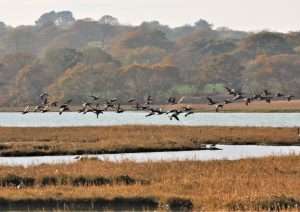
As autumn arrives, thousands of birds return to the Solent’s mudflats, saltmarshes and shorelines. Brent geese arrive from Arctic Russia, while dunlins, sanderlings and black-tailed godwits travel thousands of miles to gather on the coast to feed, rest and build up energy for the months ahead.
We’ve learned a huge amount about migration in recent decades, but birds still manage to surprise us. From reshaping their bodies for flight to reuniting with long-lost partners, here are 11 fascinating facts you might not know about bird migration.
1. Birds can remodel their bodies before migration
Long-distance migration demands huge amounts of energy. Many birds dramatically increase their body weight before setting off, building up fat reserves that act like aviation fuel for their journey. Some species can nearly double their weight in the weeks before departure.
A black-tailed godwit migrates to the Solent from Iceland every autumn
Even more remarkably, birds may temporarily reduce the size of organs they won’t need as much during flight, such as parts of their digestive system, while maintaining the muscles needed to power long-distance travel.
This means feeding opportunities are crucial when birds arrive or before they set off on their long migratory journeys.
2. Some birds carry an internal migration calendar
Scientists have found that birds possess internal biological clocks that regulate annual cycles of breeding, moulting and migration. Even birds kept indoors can become restless at the same time each year, despite experiencing different weather from their wild counterparts.
3. We still don’t fully understand how birds navigate
Despite decades of research, migration still contains plenty of mystery.
Scientists think birds use a combination of tools, including the Earth’s magnetic field, the position of the sun and stars, and landmarks such as rivers and coastlines. Exactly how they combine all this information remains one of nature’s great puzzles.
4. Some birds travel with family, while others go it alone
Dark-bellied brent geese, one of the Solent’s most iconic winter visitors, usually travel in family groups. Parents and young birds stay together and migrate alongside one another, helping youngsters learn feeding sites and migration routes.
Other species take a very different approach. Young cuckoos, for example, travel to Africa on their own without any help from their parents, completing a journey they’ve never made before.
Brent geese stay in family groups
5. For centuries, nobody knew where migratory birds went
For most of human history, migration was a complete mystery.
Some people believed barnacle geese grew from goose barnacles attached to driftwood because nobody had ever seen them nesting. Even the naturalist Gilbert White suggested that swallows might hibernate in mud at the bottom of ponds.
6. A stork with a spear changed science
One of the most important clues about bird migration arrived in Germany in 1822.
A white stork was discovered with a spear through its neck that scientists recognised as originating from central Africa. The bird had somehow survived being struck, flown thousands of miles and returned to Europe.
Known as the Pfeilstorch or “arrow stork”, it provided some of the first direct evidence that birds travel vast distances.
7. Caged birds helped unlock the mystery of migration
Long before ringing or satellite tags, scientists noticed that some captive birds became unusually restless in spring and autumn.
The birds repeatedly fluttered against the same side of their cages, as if trying to head in a particular direction. This distressing behaviour, known as ‘zugunruhe’ or migratory restlessness, provided an early clue that migration is driven by instinct.
8. Not every bird leaves on the same schedule
Favourable winds and storms can influence exactly when birds depart.
However, some species appear strongly tied to their annual schedule and leave at much the same time each year regardless of short-term weather conditions. Migration is often shaped by both environmental conditions and an internal clock.
9. Some couples spend the winter apart
Black-tailed godwit pairs breeding in Iceland can spend the non-breeding season more than 1,000 kilometres apart before reuniting the following spring in Iceland within days.
10. Birds can return to the exact same place year after year
Many migratory birds show remarkable loyalty to particular locations.
They don’t just return to the same country or estuary. Some return to the same stretch of coastline, feeding area or breeding territory year after year, sometimes with astonishing accuracy.
For many birds wintering on the Solent, the mudflats and shorelines they use today may be the same places they’ve relied on for years.
11. Not all members of a species migrate
Migration isn’t always an all-or-nothing behaviour.
Oystercatchers provide a good example. Some remain in the same area throughout the year, while others migrate. Research suggests that young birds may learn this behaviour from their parents, particularly their fathers, which tend to remain involved in raising chicks for longer.
Record-breakers
Bar-tailed godwits have become famous for achieving some of the longest non-stop flights ever recorded.
In 2022, a juvenile bar-tailed godwit flew 13,560 kilometres from Alaska to Tasmania without stopping to feed or rest, setting a new record for the longest documented non-stop migration by a bird.
A bar-tailed godwit
Like this record-breaking godwit, the birds that spend the winter on the Solent arrive after demanding journeys across countries, seas and continents. Once they get here, they need time to rest and rebuild the energy reserves they’ve used along the way. They’ll then need to spend the winter feeding up for the return journey to their breeding grounds in spring.
This means the Solent’s mudflats, saltmarshes and shorelines are vital, providing the food and space birds need to recover from migration and prepare for the journeys still to come.
By giving feeding and resting birds a little space, we can help them conserve valuable energy for the challenges ahead.
