
We’re almost halfway through this year’s Great Coastal Birdwatch and the rangers have got off to a busy start.
Between taking part in guided walks and pop-ups, Ranger Rachel found time to spend an hour making a note of the birds she could spot at East Head so she could submit her findings to this year’s birdwatch.
Ranger Rachel
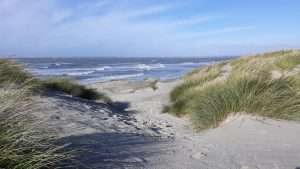
Nestled in amongst Chichester Harbour, East Head is one of the last surviving pieces of natural coastline in West Sussex. The shifting sand dunes, saltmarsh and flowing tides make it a fantastic spot to spy some of the returning winter visitors to our shores.
With binoculars and trusty scope in hand, Rachel carefully ventured out along the path between the dunes and saltmarsh to the sound of skylarks and gentle breaking waves.
It wasn’t long until she spotted her first contenders for her birdwatch count, out in the harbour.
A group of around 20 brent geese rested, bobbing about between the sailing boats moored nearby, their distinctive chatter carrying across the water. These birds have recently arrived from Arctic Siberia, making the 3,000-mile journey to spend the winter in our milder environment, often returning to the same wintering areas year after year, where they gather in large groups to rest and munch on seagrass. You can just imagine these birds breathing a sigh of relief as the distinctive outline of East Head comes into view after their mammoth journey.
Closer to the shore, another fantastic gathering of birds could be seen, a congregation of golden plovers. This collective noun was given to the plovers way back in the fifteenth century because they are very social birds who gather, or “congregate,” in massive, tightly packed flocks on the ground.
As the sun momentarily peeked through the clouds above, the glint of warm golden colouring certainly stood out, contrasting with the cooler tones of a nearby smaller group of grey plovers and the steely blue of the sea behind. Both golden and grey plovers have shorter beaks and larger eyes relative to their head size than many other wading birds. This gives them better low-light vision and, arguably, a very cute appearance too!
Golden plovers
Grey plover
As the golden and grey plovers stood sentinel, holding out for as long as possible before the rising tide forced them to move, some smaller, very busy birds darted between them. Rachel identified these as dunlins and ringed plovers, both roughly starling-sized.
The ringed plover has a distinctive black band across its face, making it look rather like a masked bandit, while the dunlin, in its winter grey plumage, appeared soft grey and silver against the sand and mud. Despite their tiny size, weighing only about the same as a tennis ball, these birds may have travelled hundreds or even thousands of miles from breeding grounds across northern Europe and beyond to spend the winter here.
Dunlin
Ringed plover
As the tide continued to rise, the congregation parted ways and flew to their high-tide roosts. Rachel made her way back home, but not before spotting a flock of meadow pipits bobbing above the saltmarsh, lapwings with their slow, rounded wingbeats, and teals and herons heading off to feed and rest.
This was just a small snapshot of the incredible wildlife that calls our coastline home during the autumn and winter months, giving us the chance to welcome and witness some of nature’s most remarkable travellers right on our doorstep.
Here’s the list of species Rachel spotted during her Great Coastal Birdwatch:
- Skylark
- Dark-bellied brent goose
- Golden plover
- Grey plover
- Dunlin
- Ringed plover
- Meadow pipit
- Lapwing
- Teal
- Grey heron
- Kestrel
- Sandwich tern
- Linnet
- Redshank
- Oystercatcher
- Little egret
If you’re out on the coast between 17 October and 1 November, why not see what you can spot during your Great Coastal Birdwatch and share your sightings with us?
